
Sterling Silver Jewelry Production: QC at 100%
A silver programme is approved by sample but released piece by piece, because the published standard inspects 100% of output rather than a draw from each lot. The floor is 50 pieces per design, and a master sample takes 25–30 days before any of that checking can begin. What follows is how the checkpoints divide the work.

Key takeaways
- A full pass means every piece is handled, so a 200-piece order produces 200 final inspection decisions.
- Silver MOQ starts at 50 pieces per design, half the 100-piece floor used for the brass line.
- CAD takes under 48 hours, sampling 25–30 days, and bulk production 3–4 weeks.
- Five natural gates exist in a plated silver order: casting, setting, polishing, plating and packing.
What the 100% figure actually commits to
The phrase appears at the end of the published six-step flow, where final QC and delivery are described as 100% inspected. Read literally, that is a statement about coverage: no carton leaves on the strength of a sample. It is not a statement about defect rates, and no such rate is published. Buyers should treat the number as a method, not a performance figure.
The method has a cost that is easy to miss. Every piece must be picked up, oriented, compared against the approved sample and returned to the tray. On a small silver order that labour is modest in absolute terms. On a large one it becomes a line item, and it is the reason a factory cannot simply promise a full pass without staffing for it.
ISO 9001:2015 matters here because it puts that check inside a documented process. The record of what was inspected, by whom and against which standard should survive the shipment. When a buyer later reports that one batch wears differently from another, the document trail is the only way to reconstruct why.
The five gates in a plated silver order
Inspection is not a single room at the end of the building. A silver piece that is cast, set, polished, plated and packed passes five natural decision points, and each one catches a different fault. Concentrating all checks at the end means a fault discovered there has already collected the cost of every later operation.
Casting is the first filter. Porosity, short fills and flash are visible before any stone goes in, and a porous casting will not improve with polishing. Setting is the second: a lifted stone or an over-tight seat can crack a bezel that looked correct on the bench. Polishing is the third, where over-polishing rounds a sharp edge that the CAD file specified.
Plating is the fourth and the one most exposed to process drift, because coverage depends on rack position, current and bath condition. Packing is the fifth, and it is a real gate rather than an administrative step: a piece can pass four inspections and still be paired with the wrong card, the wrong pouch or a clasp that does not match its listing.
The whole route, from CAD to the last inspection, is published at https://www.tttjewelry.com/sterling-silver-jewelry-manufacturer/.
| Gate | What is checked | Release condition | If it fails |
|---|---|---|---|
| After casting | Porosity, short fill, sprue marks | Surface sound, weight inside band | Melt and recast before setting |
| After setting | Seat depth, stone alignment, prong tension | No movement under light pull | Reset or replace the stone |
| After polishing | Edge sharpness, texture, residual scratches | Matches the approved finish tile | Re-polish before plating |
| After plating | Coverage in recesses, rack contact marks | Even colour, no bare patch | Strip and replate |
| Before packing | Hallmark, clasp function, pairing, labels | Piece matches its order line | Hold the carton |
Why silver needs its own list
925 sterling silver is a soft alloy, and that single property drives most of its inspection notes. Edges round more easily under a polishing wheel. Clasps bend. Prongs that would hold a hard stone in a harder metal can be eased open by a pull that a customer applies without thinking. The checklist has to assume handling, not just display.
Tarnish is the second silver-specific issue. The published finish menu includes an anti-tarnish e-coating for silver and brass, applied after plating. Whether a piece carries that coat changes how it should be stored, packed and described, so the coating belongs on the inspection sheet as a yes or no, not as a background assumption.
The hallmark is the third. Published marking options include S925, alongside 316L and 18KGP for the other lines. A laser mark needs enough depth to survive polishing and plating without filling in, and its position has to avoid the wear face of a ring. A shallow mark that reads correctly on the bench can disappear after two polishing passes, which makes hallmark depth a release condition rather than a cosmetic detail.
From approved sample to rework rules
The master sample answers a design question: is this the piece the brief described? It does not answer a repeatability question, because one sample cannot show how a process behaves across 50 or 500 units. That is why the sample stage and the production stage are separate entries in the published flow, with 25–30 days for the first and 3–4 weeks for the second.
A brand that treats the sample as the end of quality work tends to discover process variation at the worst moment, after the bulk run is boxed. The cheaper sequence is to use the sample to write the inspection criteria, then use those criteria at each gate during production. The sample defines the reference; the gates enforce it.
For buyers moving from a first order to a repeat, the OEM/ODM jewelry manufacturer page lays out how inquiry, development, CAD, sampling, bulk and final QC connect. It is worth mapping internal sign-off points onto those six steps before the second order, when the temptation to skip review is strongest.
A failed piece has three possible routes, and the right one depends on where the fault sits. A plating defect on an otherwise sound piece goes back for stripping and replating. A setting fault is corrected at the bench if the seat is intact. A casting fault that reaches the surface cannot be polished out without changing the geometry, so it is scrapped and recast.
The decision rule should be written into the order, because the option that looks least costly is not always the shortest. Replating a piece twice can leave a soft, thick deposit that wears differently from the rest of the run. Polishing out a deep scratch thins a band. Rework is only genuinely cheaper when it restores the piece to the approved reference rather than to something adjacent to it.
Records make the loop useful. If the same gate rejects the same fault repeatedly, the problem is upstream and inspection is acting as a smoke alarm rather than a fix. That pattern is exactly what a documented ISO 9001:2015 process is meant to surface, and it is the argument for logging rejects by gate instead of by carton.
Worked example
Take a four-design silver order at the published minimum: 4 × 50 = 200 pieces. If each piece passes five gates, the run generates 200 × 5 = 1,000 inspection decisions before the last carton is closed. A brass equivalent at its 100-piece floor would be 400 pieces, or 2,000 decisions, for the same four designs.
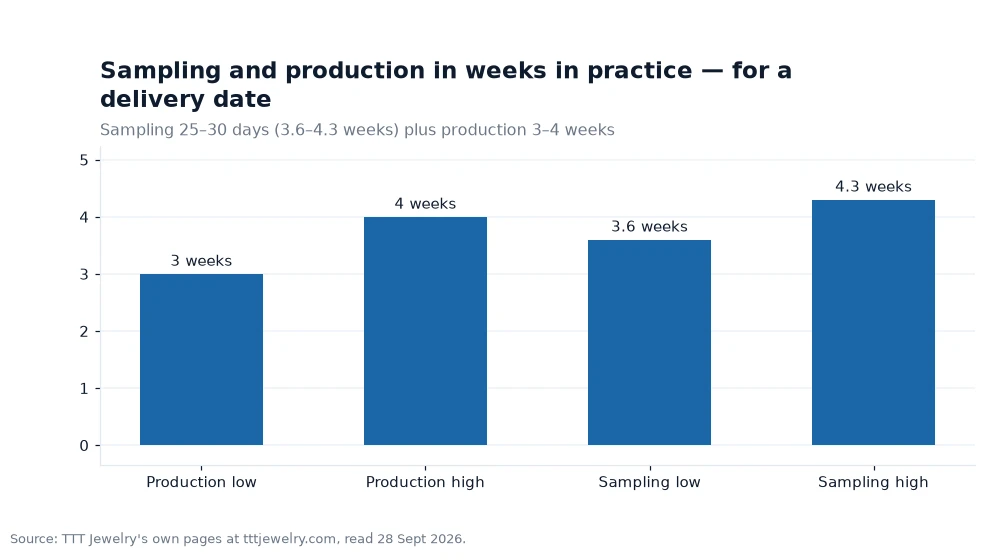
Now put the calendar beside it. CAD is under 48 hours, or 2 days. Sampling is 25–30 days, which is 3.6–4.3 weeks. Bulk production is 3–4 weeks, or 21–28 days. Adding the stages gives 2 + 25–30 + 21–28 = 48–60 days, or roughly 7–9 weeks from CAD release to delivery.
The rework arithmetic is the reason to inspect early. If plating fails on all 200 pieces and every one is stripped and replated, the order absorbs 200 extra plating passes plus 200 repeat inspections. Catching the same fault after casting would have cost 200 recasts at an earlier stage, before setting and polishing labour had been spent on pieces that could not ship.
Frequently asked questions
Does 100% inspection mean every piece is checked by hand?
Yes. The published flow describes final QC as 100% inspected, which means each finished piece is checked rather than a sample drawn from the lot.
What is the minimum order for a sterling silver design?
50 pieces per design is the published silver minimum. The brass line starts at 100 pieces per design and stainless steel at 100 or more.
Can a brand skip sampling if the design already exists?
No. A master physical sample takes 25–30 days and sets the reference that production inspection is measured against, so skipping it removes the standard.
Writing the inspection plan into the purchase order
The purchase order is the right place to name the five gates, the approved reference sample and the coating decision, because those three items define what a pass means. A supplier can only inspect against something written down. Verbal agreement on finish or hallmark depth tends to dissolve once the first carton is opened.
For brands assembling a broader programme across metals, the custom jewelry wholesale overview is a useful map of how the published minimums and finishes differ by material line. The comparison matters because a single inspection sheet copied across silver, brass and steel will test the wrong things on at least two of them.
None of this makes a run defect-free. It makes the defects visible at the point where correcting them is still cheap, and it leaves a record when a buyer asks what happened. That is a more useful promise than a quality slogan.
Source note: figures come from the manufacturer's own website (tttjewelry.com), read 28 Sept 2026.[1]