
Chinese Scent Materials in a Modern Brief: A Scope Checklist
Chinese scent materials are easy to name and hard to brief. Osmanthus, tea, sandalwood, rice and incense all carry meaning, and all of them can be interpreted in ways that a factory cannot cost, source or document consistently. The way through is to decide the scope first: which materials are literal, which are reconstructed accords, what documentation each one needs, and how much of the range depends on them. Settle that and the brief becomes workable; skip it and the development round turns into a debate about what the words meant.
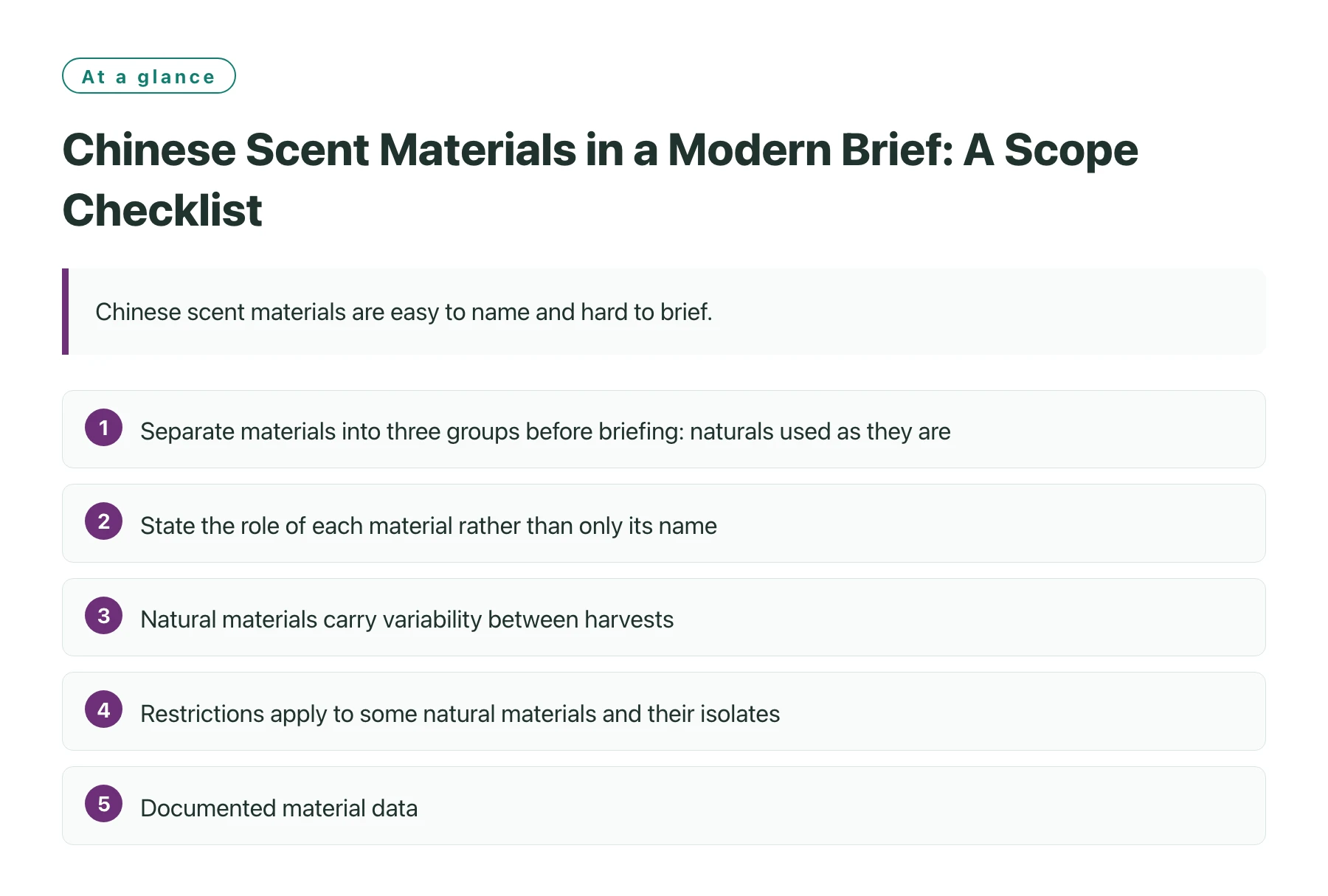
Key takeawaysSeparate materials into three groups before briefing: naturals used as they are, reconstructed accords that evoke a material, and cultural references that are carried by the composition as a whole. · State the role of each material rather than only its name, because a tea note at the heart of a composition and a tea note as a top-note impression require very different work. · Natural materials carry variability between harvests, so a brief built on a single absolute needs a defined tolerance or a reconstructed alternative for consistency. · Restrictions apply to some natural materials and their isolates, which makes the assessed product category part of the creative decision rather than a later check [1]. · Documented material data, including odour descriptions and typical usage ranges, is available from public reference sources and is a better briefing input than a mood board [2]. · Cultural references deserve documentation of their own, and the practices behind tea, incense and festival materials are formally recorded in heritage programmes rather than being folklore a brand can restate loosely [3].
A Chinese-inspired range usually begins with a short list of evocative materials and a strong visual reference. Both are useful and neither is a brief. Between the list and a production-ready composition sit decisions about whether materials are literal or reconstructed, how they behave over time, what restrictions apply, and how consistency is maintained across repeat orders.
This is not unique to Chinese materials, but it is sharper with them, because the names carry cultural weight and the materials themselves are often expensive, variable or restricted. A brief that names osmanthus without saying whether the reference is the flower, the absolute, a tea pairing or a memory will produce a submission that satisfies none of those readings.
The checklist below is organised as a scope document rather than a creative brief. Its job is to remove ambiguity before the perfumer starts, so that the creative work is spent on interpretation rather than on definitions.
The scope checklist, in the order to settle it
- Classify each material as literal, reconstructed or referential.Literal means the material is used as itself. Reconstructed means an accord evokes it. Referential means the composition carries a cultural idea without a single identifiable material. Every name in the brief should sit in one of the three groups.
- Name the role and the position.Top, heart or base, and whether the material leads or supports. A tea material leading a composition is a different brief from tea used to soften a floral heart, and the sourcing and cost consequences differ.
- Set the dosage intention in broad terms.Nothing precise is needed at briefing stage, but the difference between a trace, a signature and a dominant material should be stated, because it determines whether the formula is feasible at the target cost.
- Decide the consistency requirement.If a natural absolute is specified, agree what happens when the next lot smells slightly different: a stated tolerance, a retained reference, or a reconstructed accord that holds the profile steady.
- Check the restriction position before selection.Ask which candidate materials carry use limits and how much headroom the intended dosage leaves in the assessed category, so that a beautiful direction is not chosen and then abandoned [1].
- Decide how the cultural reference is carried.Whether through a specific material, a pairing, or the structure of the composition. This decision prevents a range from making a claim in marketing that the formula cannot support.
- Attach the documentation expectations.Ingredient naming, allergen declaration and the material documentation the brand will keep. These inputs hold up artwork, so their format should be agreed rather than assumed.
Materials, roles and what has to be settled
| Material family | Common role in a brief | What must be settled before development |
|---|---|---|
| Osmanthus | Fruity-floral signature, often paired with tea or apricot-like notes | Whether the reference is the flower, an absolute or a tea pairing, and how the profile is held consistent between lots |
| Tea | Fresh or roasted accord, used as a top or heart depending on the intended mood | Whether the brief asks for a green, roasted or fermented character, since these read very differently in wear |
| Sandalwood-type materials | Base support, creaminess and longevity | Which material class is acceptable at the target cost, and the restriction position of the chosen option |
| Incense and resin notes | Atmosphere and depth, often used sparingly | Dosage intention and the product category, because the assessment follows the category rather than the scent |
| Rice, grain and milk-like notes | Softness and skin-adjacent comfort | Whether the effect is achieved through a specific material or an accord, and how it is documented for labelling |
| Floral absolutes | Heart structure and recognisability | Variability tolerance, sourcing expectations and the fallback if a lot does not match the reference |
Worked examples help here more than definitions, particularly when a brand is trying to describe a direction that sits between two traditions. A documented walkthrough of how heritage notes are combined in practice, such as Xuelei's guide to Chinese scent materials, gives the development team a reference vocabulary to argue with rather than a style to copy.
Where Chinese-material briefs go wrong
The most common failure is treating a material name as a specification. Osmanthus is a flower, an absolute, a family of accords and a set of cultural associations, and a brief that offers only the word hands the interpretation to whoever reads it first. The second most common failure is the opposite: over-specifying a natural material to the point where consistency becomes impossible across repeat production.
A third failure sits on the documentation side. Brands often assume that a heritage-inspired range needs less compliance work because the materials are traditional. Traditional materials are still cosmetic ingredients, and the documentation burden is unchanged. What changes is the marketing story, which is the part that needs the most care precisely because it is the part a brand controls.
Building the reference library
Before the brief is written, the team should smell the candidate materials at several dilutions and record impressions in a shared format. This is not a formality: many directions that read well on paper are rejected in the first session, and finding that out before the brief is cheaper than finding it out in the third sample round.
Public reference sources that document odour descriptions and typical usage help turn impressions into something a factory can respond to, because they give the brief a vocabulary that is shared rather than personal [2]. A broader survey of the material families behind these notes, such as an overview of Chinese perfume ingredients, is useful background before the first smelling session.
Where a brand is working with a development partner rather than an in-house perfumer, the library also improves the conversation. A partner that works as a custom fragrance development partner will usually ask for exactly this material, and having it ready shortens the first development cycle. Combined with internal notes, it becomes a reference library the brand keeps and reuses, which is an asset independent of any single supplier.
Documenting the cultural reference
Heritage-inspired ranges carry an obligation that purely commercial ranges do not. Practices around tea, incense and festival materials are living traditions, and some of them are formally documented in heritage registers rather than being free-floating imagery [3]. Using them as a scent direction is normal; restating them loosely as brand mythology is where ranges attract criticism.
The practical approach is to describe the reference accurately in internal documents, agree with the supplier which parts of it the composition is meant to carry, and keep marketing language within what the formula and the research can support. A brand that can explain its own material choices is much harder to undermine, and it also briefs better, because the explanation forces the team to be specific about what it actually wants.
Where the range will be produced at volume, it is also worth confirming the manufacturing side of the story early. A house that works with these materials across categories and markets can describe how they behave in production, and what it publishes about Xuelei is a reasonable starting point for judging whether that experience is documented and current.
One discipline turns a Chinese-inspired brief from a debate into a document: write one sentence for every material that says what it is doing in the composition, and delete any material that cannot be given a sentence. A range built from six justified materials will out-perform a range built from fifteen evocative names, because every addition to a formula is also an addition to the sourcing, restriction and documentation work behind it.
Sources
- IFRA Standards Library (International Fragrance Association) —— The IFRA Standards Library lists the restrictions the fragrance industry applies to individual fragrance ingredients, based on safety assessments; it is the reference point for compliant fragrance formulation.
- The Good Scents Company —— A reference database of aroma materials with odour descriptions, CAS numbers and typical usage information.
- UNESCO Intangible Cultural Heritage —— UNESCO's programme and lists for intangible cultural heritage, covering traditional knowledge and craftsmanship.
Frequently asked questions
Do Chinese scent materials cost more than their Western equivalents?
It depends entirely on the material and the form. Some absolutes and specialty accords are expensive, while many modern reconstructions are cost-effective and more consistent. The practical question for a brief is not origin but whether the brand needs the natural material, a reconstruction, or only the impression, because those three options differ substantially in cost and supply stability.
Can a brand claim that a fragrance contains a traditional material?
Only where the claim matches the composition and can be supported. Marketing language about heritage materials should reflect what the formula actually contains and what the documentation shows. Vague cultural claims are both harder to defend and less persuasive than a specific, accurate description of the material and its role.
How should a brand handle natural variability between lots?
Decide in advance. Either specify a tolerance range and keep a retained reference to compare against, or use a reconstruction that holds the profile steady, or accept a stated variation as part of the character. Leaving it undecided means a complaint at the second order, when the natural material differs slightly from the sample that was approved.
What documentation should accompany a heritage-material line?
The same set as any cosmetic fragrance: safety assessment, ingredient and allergen inputs in label-ready form, a specification, and the records that link a delivered batch to the approved reference. Heritage positioning adds research responsibility for the cultural claims, not a reduction in the compliance work.
Is it better to brief several directions or one?
Several, but not many. Two or three clearly differentiated interpretations of the same intention give the team something to compare and reveal what the words actually meant. One submission cannot be judged, and five tend to produce a selection based on preference rather than on fit with the brief.
Found this useful?
Join 14,200+ NSUK students trading safely on campus. List something in minutes — keep your semester cash.